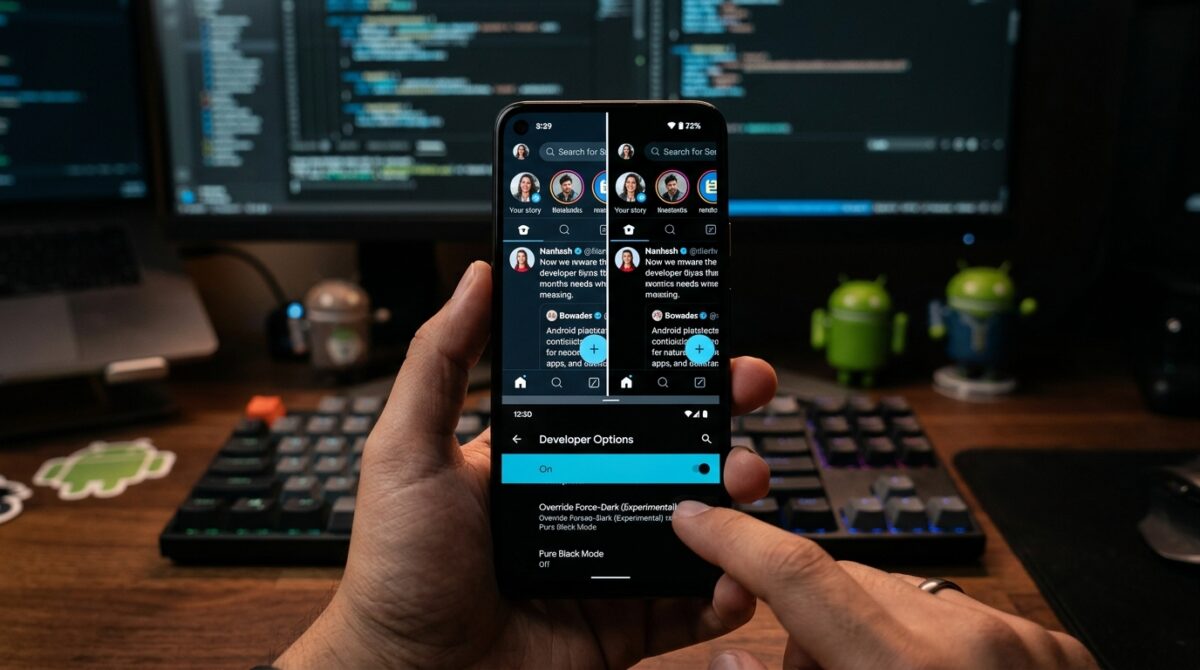
The Hidden Android Developer Setting That Forces Incompatible Apps into True Pitch-Black Dark Mode
Not only does dark mode have visual appeal, but it also has the ability to save battery life on OLED panels and minimize eye strain in low-light conditions. Dark mode has become a common feature across all smartphones and applications. On the other hand, not all Android applications have natural support for dark mode, and even those that do often implement it with varying shades of gray rather than complete blackness. This reduces the potential advantages to the battery as well as the visual contrast. Android has a secret developer feature that includes the ability to override program defaults and impose full pitch-black dark mode. This setting is available to consumers who want a consistent, deep-black experience across all of their applications. Despite the fact that this setting is hidden away in the developer settings and is not frequently marketed, it has the potential to significantly alter the look of applications that would otherwise continue to employ subdued dark tones or stay bright. Power users may create a more consistent dark mode experience by gaining an understanding of how to access and utilize this function in a secure manner using this feature.
Utilizing Android’s Developer Options to Access Options
The first thing you need to do in order to use this secret dark mode setting is to enable developer settings on your Android device. The vast majority of contemporary Android phones conceal this menu in order to avoid unintended modifications to the advanced system settings. To unlock it, users often need to go to the “About Phone” part of the settings menu and repeatedly touch the “Build Number” until a confirmation message displays. This is the only way to unlock it. Once the developer options menu has been opened, it will become available under the main system settings. This menu offers a variety of advanced options, such as USB debugging, animation changes, and experimental system features. Having access to this menu is necessary in order to force incompatible applications to operate in a pitch-black dark mode.
Finding the Override Force-Dark Setting in the System
It is standard practice to refer to the particular setting under the developer settings that allows deep black dark mode as “Override force-dark” or “Force dark mode for applications.” This feature, when activated, compels applications that do not have the capability to support dark mode by default to adopt a dark theme, therefore transforming elements of lighter colors into dark counterparts. The algorithm of the system makes an effort to intelligently reverse colors while maintaining the visibility hierarchy and readability of the content. By using this method, applications that have dark mode implementations that are inconsistent or incomplete may show in a manner that is visually cohesive and closer to genuine black. This is especially beneficial for OLED displays, which have pure black pixels switched off, which helps save battery life over time.
Apps that are not compatible with the setting and how it works
Regardless of the applications’ underlying coding, the override setting will apply a universal dark theme to all of them. This option operates at the system level. The results may vary depending on the design of the app, but this indicates that even older applications or those that do not have official support for dark mode may display in pitch-black mode. The system does an analysis and makes modifications in real time to the buttons, text, backgrounds, and menus. It does this by inverting bright colors while preserving contrast for readability. Despite the fact that not all visual aspects can be changed to perfection, this option makes a considerable improvement to the overall dark mode experience across all applications that would otherwise stay bright or employ restricted grayscale schemes.
True Pitch-Black Dark Mode’s Advantages and Benefits
The reduction in power usage that occurs on OLED panels is one of the primary benefits that comes with imposing pitch-black dark mode. However, in contrast to LCD panels, OLED pixels produce their own light, which means that rendering pixels entirely dark results in a low amount of energy consumption. Users that spend extended amounts of time reading, surfing, or using social networking applications may benefit from this feature since it may increase the battery life of their devices. Because it provides a greater contrast between the text and the backdrop in low-light conditions, pitch-black dark mode also helps to prevent eye strain. This override at the system level provides a consistent and immersive experience for users who are sensitive to brightness or who want a dark interface that is visually coherent.
Limitations and possible inconsistencies in the visual presentation
The use of dark mode on applications that were not intended for it may sometimes result in visual discrepancies, despite the fact that it has a number of inherent benefits. It is possible that some pictures, icons, or custom user interface components may not invert effectively, which may result in color schemes that are uncomfortable or poor readability. Animations and video content are also unaffected, which means that some parts of the application may continue to display their original brightness. Additionally, if the dark mode override interacts negatively with the existing style of the app, it is possible that some applications may have layout difficulties. Users should be aware that while this feature does enhance consistency, it is not a perfect solution and may need selective usage based on the applications that are involved.
Optimizing the Experience Through the Configuration of the System
Users have the ability to combine forced dark mode with other system-level settings in order to get the most out of its associated advantages. To enhance readability and comfort, it is possible to adjust the overall brightness, enable adaptive brightness, and configure display color profiles. Some versions of Android provide users the ability to set dark mode at particular times, which ensures that the override has a consistent effect during nighttime or low-light usage. To further minimize power consumption while keeping a seamless experience, it is possible to disable animations or transitions that use a significant amount of battery power. Combining these parameters in the right way improves not just the aesthetic attractiveness of pitch-black dark mode but also its functional advantages.
The When and Why of Utilizing This Function
Users that place a high priority on reducing eye strain, maintaining visual uniformity, and preserving battery life will find that entering incompatible applications into a pitch-black dark mode is the most beneficial option. This option is especially beneficial to power users, those who use social media often, and people who use gadgets that display on-screen displays. Casual users, on the other hand, can find the occasional visual anomalies or layout peculiarities to be confusing and annoying. Users are able to take use of the advantages without sacrificing usability if they have a thorough understanding of the trade-offs and when they selectively enable the feature for applications that get the greatest usage. On Android devices, the secret developer override offers a strong and often neglected alternative for users who are looking for a dark interface that is completely immersive across all of their devices.