Dual Band vs Tri-Band Mesh Routers: Concrete Wall Penetration and Latency Drops in Multi-Story Homes
In today’s contemporary homes, where streaming, remote work, gaming, smart gadgets, and cloud-based apps all rely on constant internet access, it has become an absolute must to have reliable wireless coverage. In bigger homes, particularly those with many storeys and concrete structure, traditional single-router installations often have difficulties. A significant number of homes are turning to mesh networking solutions in order to address these coverage issues. Nevertheless, selecting a mesh router that is either dual-band or tri-band is not always an easy task. Despite the fact that wall materials, floor layouts, interference levels, and the manner in which mesh nodes interact with each other have a significant impact on real-world performance, marketing materials often place an emphasis on speed and coverage. It is helpful for homeowners to have an understanding of how dual-band and tri-band systems deal with concrete wall penetration and network latency. This allows them to pick the most effective solution for locations that are demanding.
An Understanding of the Operation of Mesh Networks
Through the use of a number of linked nodes, a mesh network is able to provide wireless coverage across an entire house. Instead of depending on a single router to reach every room, mesh nodes establish coverage regions that overlap with one another and transmit data between each other. In areas where a standalone router would have difficulty, this configuration makes it possible to boost signal availability. It is not just the strength of individual nodes that determines the success of a mesh system; it is also the quality of communication that exists between those nodes that determines how effective the system is. One of the most important factors that determines the overall performance of a network is the backhaul process, which is a communication process.
Comparing Dual-Band Systems to Tri-Band Systems: What The Difference Is
In most cases, dual-band mesh routers need one 2.4GHz band and one 5GHz band in order to function properly. Client devices and communication between nodes share both bands and use them for their own purposes. There is an extra wireless band, often another 5GHz channel, that is added to tri-band systems. This additional band may be allocated to communication between wireless mesh nodes. Having this additional band minimizes the amount of rivalry that exists between connected devices and the mesh backhaul. When there is a rise in network traffic, the dedicated communication channel that is provided in many tri-band designs often improves efficiency. This is true even if both systems are capable of providing very good coverage.
The Reasons Why Concrete Walls Make Wireless Signals Struggle
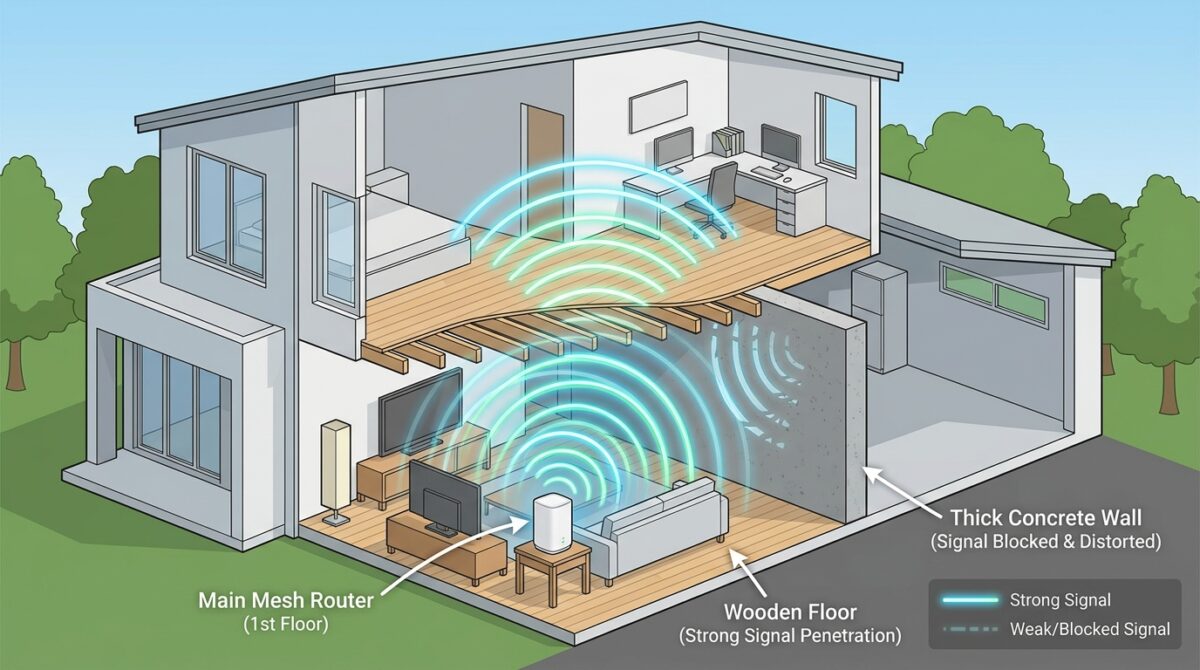
In terms of the difficulty of transmitting wireless signals through building materials, concrete is among the most challenging. Concrete is a material that, in contrast to drywall or timber walls, has thick elements that absorb and weaken the transmission of radio frequency waves. Due to the fact that metal reinforcing substantially hinders signal transmission, reinforced concrete may be much more troublesome than other types of concrete. Significant reductions in the power of wireless signals occur when they go through a number of concrete walls or floors. Additionally, this decrease has an impact on the communication between mesh nodes as well as user devices. As a consequence, the speeds may decrease, the latency may rise, and the overall dependability of the network may decrease.
How Frequency Bands Contribute to the Process of Wall Penetration
There is a difference in the behavior of various wireless frequencies when they come into contact with impediments. It is usually true that signals operating at 2.4GHz go farther and penetrate barriers more effectively than those operating at 5GHz. In most cases, however, it provides maximum speeds that are lower and is subject to a greater amount of interference from other home equipment. The throughput of the 5GHz band is greater, but it has a harder time dealing with solid objects like concrete. Due to the fact that tri-band systems sometimes depend significantly on extra 5GHz channels for backhaul communication, the location of nodes becomes especially crucial in residences that have thick walls and numerous levels.
How the Backhaul Affects the Performance of the Network
There is a correlation between backhaul communication and the efficiency with which mesh nodes exchange data. The same wireless resources are required to service both client devices and traffic between nodes in a dual-band system’s architecture. When a large number of devices are connected, the available bandwidth is shared among several jobs that are vying for it. Utilizing a tri-band system allows for the allocation of a whole band to backhaul communication, which in turn helps to alleviate congestion and enhance overall efficiency. This separation often leads in more constant speeds and reduced latency, particularly in situations where there is intensive network utilization or when nodes are located many rooms distant from one another.
Distinctions in Latency Among Homes with Multiple Stories
The term “latency” refers to the amount of time that is necessary for data to move across a network. There is a possibility that latency may rise in multi-story residences as a result of data traveling via extra mesh nodes or coming into contact with signal degradation brought on by walls and floors. Due to the fact that client traffic and backhaul traffic fight for the same wireless resources, dual-band systems may incur higher variations in latency. By keeping node communication distinct, tri-band systems are able to typically maintain a more constant latency. When it comes to real-time applications that rely on short reaction times, such as online gaming, video conferencing, and other similar activities, this advantage becomes increasingly obvious.
The placement of nodes is more important than the specifications.
In the actual world, the positioning of nodes often has a bigger influence on performance than the specs of the router, which is the primary emphasis of many homeowners. If there are several concrete barriers between the nodes, even the most modern tri-band system may have difficulty communicating with the other nodes. Putting nodes in positions where they can maintain robust communication linkages is a very important step. The ideal placement of nodes would be in regions where they are able to create connections that are dependable while yet providing coverage to areas that are challenging. The implementation of strategic placement may sometimes result in greater performance benefits than the implementation of an upgrade to a more costly system.
Functioning Capabilities Under Heavy Device Loads
It is common practice for contemporary families to link dozens of devices at the same time. These devices may include cellphones, TVs, computers, gaming systems, cameras, and sophisticated home appliances. It is becoming more critical to ensure that the network is efficient as the number of connected devices continues to rise. Dual-band mesh systems are able to adequately manage modest device counts; however, large traffic may reveal constraints due to the fact that backhaul and client communications share available spectrum. In general, tri-band systems are able to handle a high number of active devices more effectively. This is due to the fact that dedicated backhaul resources minimize conflict and increase data flow between nodes.
Whenever Dual-Band Systems Are Able to Meet Demand
It is not necessary for every house to have a tri-band mesh network. It is possible that a high-quality dual-band system will function very well in homes that are smaller, flats, or residences that have fewer connected devices. In situations where the location of nodes enables robust communication channels and the demands placed on the internet are reasonable, dual-band mesh routers can provide a great value. When circumstances are good, users who are mainly concerned with online surfing, streaming, and ordinary connection may not notice much of a difference between the two technologies in terms of their practical applications.
Choosing the Appropriate Mesh System for Homes Made Through Concrete
In general, tri-band mesh systems give a greater benefit for residences that have many storeys, thick concrete walls, and a high device density. This is due to the fact that dedicated backhaul connection helps sustain speeds and reduces latency. Despite the fact that the extra wireless band is unable to address the difficulties brought about by thick building materials, it has the potential to increase efficiency when there is robust connection between nodes. For locations with less requirements, dual-band systems continue to be viable choices, and when setup appropriately, they may perform surprisingly well. The mesh deployment that is most likely to be effective is one that combines the use of proper technology, careful node placement, and an awareness of how different building materials influence wireless signals. It is possible for homeowners to gain more dependable coverage and improved overall network performance over the whole of their property if they take into consideration all of these features combined.