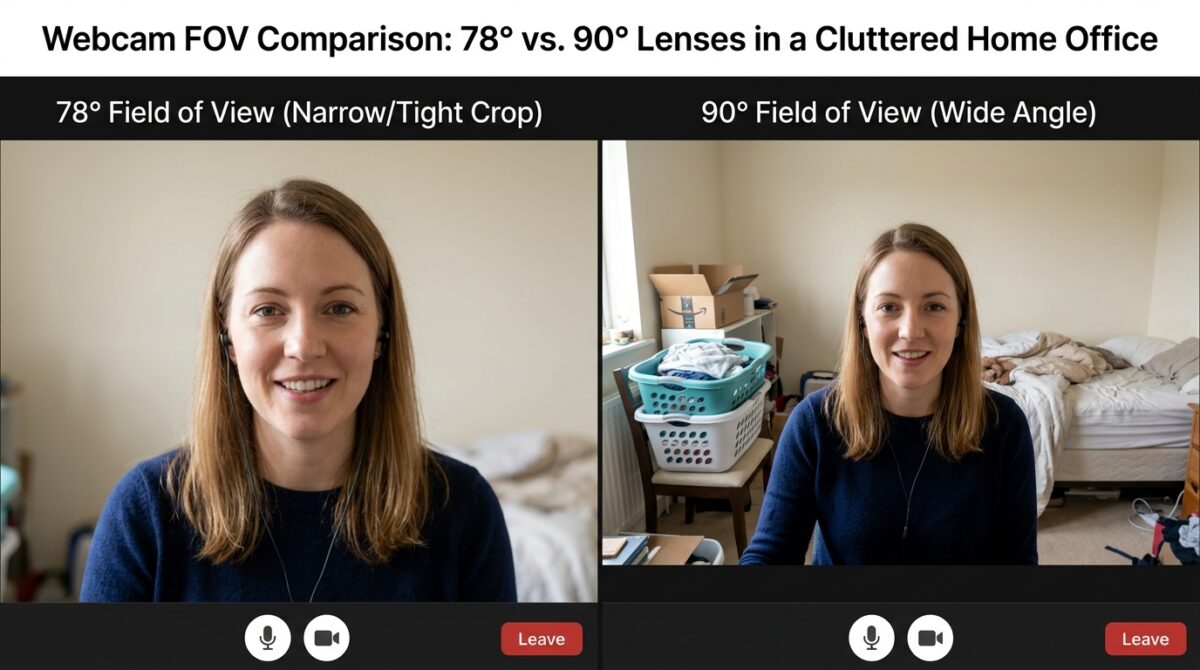
Webcam Field of View (FOV) Comparison: Choosing Between 78° and 90° Lenses for Cluttered Home Offices
The use of cameras has become an essential component of contemporary digital communication due to the proliferation of remote work, online meetings, virtual presentations, and content production. The field of vision (FOV) of a webcam is one of the most essential variables that determines how professional and pleasant a video stream looks to be. Many purchasers place a lot of importance on resolution, focusing, and microphone quality. The lens angle is what controls how much of the surrounding environment is seen as well as how the user looks when captured on camera. On paper, a 78-degree lens and a 90-degree lens would seem to be comparable; but, when compared in real-world home office settings, where factors like as space, backdrop clutter, desk arrangement, and personal framing all play a role in determining video quality, the difference becomes more apparent. Understanding how the width of the lens impacts composition, privacy, and overall presentation is necessary in order to choose the appropriate field of view.
An Explanation of the Field of View on a Webcam
The viewable area that is recorded by a camera lens is referred to as the field of vision, and it is often measured in degrees. In contrast, a smaller field of view (FOV) focuses more intently on the subject of the photograph, while a broader FOV catches more of the area in front of the camera. During video conversations, the field of view (FOV) of a camera serves to define the extent to which the user, the desk, the walls, and other background items are seen. Although a lens with a 78-degree angle offers a view that is somewhat wide and maintains the focus closer to the user, a lens with a 90-degree angle catches a wider percentage of the surrounding area. Personal framing, group visibility, or background control are the three factors that determine which option is the best option.
The Effects of a 78-degree Webcam Lens on the Framing of Videos
It is common practice to regard a webcam lens with a 78-degree angle to be a balanced solution for individual video communication. As a general rule, it frames the user’s face and upper torso while minimizing exposure to the backdrop that is entirely superfluous. Due to the fact that there are fewer things visible around the workstation, this more restricted perspective may contribute to the creation of a more organized look in a home office. This more compact composition may be beneficial to users who have limited room organization since it naturally decreases the number of distractions shown. Due to the fact that the camera concentrates more attention on the person who is speaking rather than the area around them, it is highly ideal for both professional meetings and ordinary conversation.
The Benefits of Using a Webcam Lens with a 90-Degree Angle
A lens that is 90 degrees on a camera offers a broader view, which allows it to capture more area surrounding the user. Those individuals who need to exhibit items, communicate with others, show more of their workplace, or include numerous persons in the frame may find this to be effective. When sitting farther away from the camera, having a lens that is broader also gives greater opportunity for flexibility. There are, however, certain drawbacks associated with the greater coverage. It is possible that the broader perspective will display more background information that the user would wish to keep out of the frame in situations when the room is smaller or the workplace is more crowded.
Background Disorganization and the Appearance of Professionalism
A home office would often include a variety of visual distractions, including equipment, wires, shelves, personal things, and other stuff. There are naturally more of these aspects included in a webcam lens that is broader, which might have an impact on the professional image of a video conversation. Although virtual backdrops and background blur may be helpful, they do not always eliminate distractions entirely. A 78-degree lens may be advantageous since it restricts the amount of what is seen behind the user. When it comes to professionals who routinely attend meetings, interviews, or presentations, it may be more vital to manage the visible surroundings than it is to capture a greater region.
The Impact of the Distance Between the Camera and the Subject
The field of view (FOV) is viewed differently depending on the distance between the user and the camera. It is possible that a person sitting near to a lens with a 90-degree angle would look bigger while simultaneously disclosing more of the room’s boundaries. It is possible that a person who is seated farther away might benefit from the additional width since the camera is able to catch genuine body alignment. In a similar vein, a lens with a focal length of 78 degrees may seem constrictive when the camera is position too far away. It is not only the lens parameters that define the optimal field of view; the arrangement of the desk, the location of the monitor, and the distance between the seats all have an impact on the final outcome.
Various Variations in Lens Distortion
It is possible for wider lenses to generate more obvious perspective distortion, particularly in the vicinity of the frame’s outside corners. The use of a lens with a 90-degree angle might somewhat accentuate facial features or make things that are close to the camera look bigger. Positioning the camera in such a way that it is quite near to the face makes this effect more obvious. As a result of its ability to prevent excessive edge distortion, a 78-degree lens is often able to provide a viewpoint that seems more realistic when used for single-person conversations. The use of a lens that is somewhat narrow often results in a better visual balance for users who are looking to achieve a more conventional and professional image.
Where a Wider Field of View Is More Usable
The use of a camera lens with a 90-degree angle becomes advantageous in circumstances when the capture of greater space is required. It is possible that educators, designers, engineers, and content providers may be required to demonstrate the use of actual things, drawings, demonstrations, or numerous audience members. It is possible to achieve more flexibility and eliminate the need to continually modify the positioning of the camera when using a wider angle. Users who share a workspace or who take part in collaborative sessions in which more than one person may appear on screen may also find it useful to have this feature to their advantage. In these kinds of circumstances, the additional coverage turns out to be more of a practical gain than a detriment.
Aspects to Consider Regarding Lighting and Image Quality
There is also a relationship between the field of vision and the lighting conditions and the image processing. When using a wider lens, you are able to catch more of the space, which may include places that have varying degrees of light. In order to make exposure management more challenging, strong windows, lights, or dark nooks may be present. It is necessary for the camera to analyze a more extensive view and ascertain the appropriate equilibrium between the user and the surrounding environment. By concentrating attention on a more limited region, a lens with a narrower focal length makes this job easier to complete. When the lighting at a home office is difficult, a lens with a 78-degree angle may provide an image that seems more constant.
Control of the Workspace and Confidentiality
If you are choosing a webcam FOV, privacy is another vital factor to take into mind. There are a lot of folks who would rather not expose their full workstation while they are on business calls. If you use a lens that is broader, it is possible that you could accidentally expose personal items, papers, or sections of the room that were not intended to be seen. Having a lens that is smaller gives you greater control over what really shows on camera. This extra control has the potential to make video conversation pleasant and secure for users who are working from shared houses or areas that serve several purposes.
The Choice Between 78 and 90 Degrees for a Home Office Situation
The surroundings and the reason for using the webcam both play a role in determining the optimal field of view for the camera. A lens with a focal length of 78 degrees is often more suitable for those who need a frame that is cleaner, more focused, and has less exposure to the backdrop. Individual meetings, professional communication, and smaller workplaces where it is important to limit clutter are only some of the situations in which it works effectively. The use of a lens with a 90-degree angle provides additional flexibility for demonstrations, group calls, and other circumstances in which it is advantageous to display more of the surrounding area. In the majority of congested home offices, the choice with a narrower 78-degree lens often produces a more refined look. On the other hand, the wider 90-degree lens is preferable for customers who want greater area coverage. It is possible for users to design a video setup that is more successful and professional if they have a better understanding of how field of view interacts with room architecture and camera arrangement.