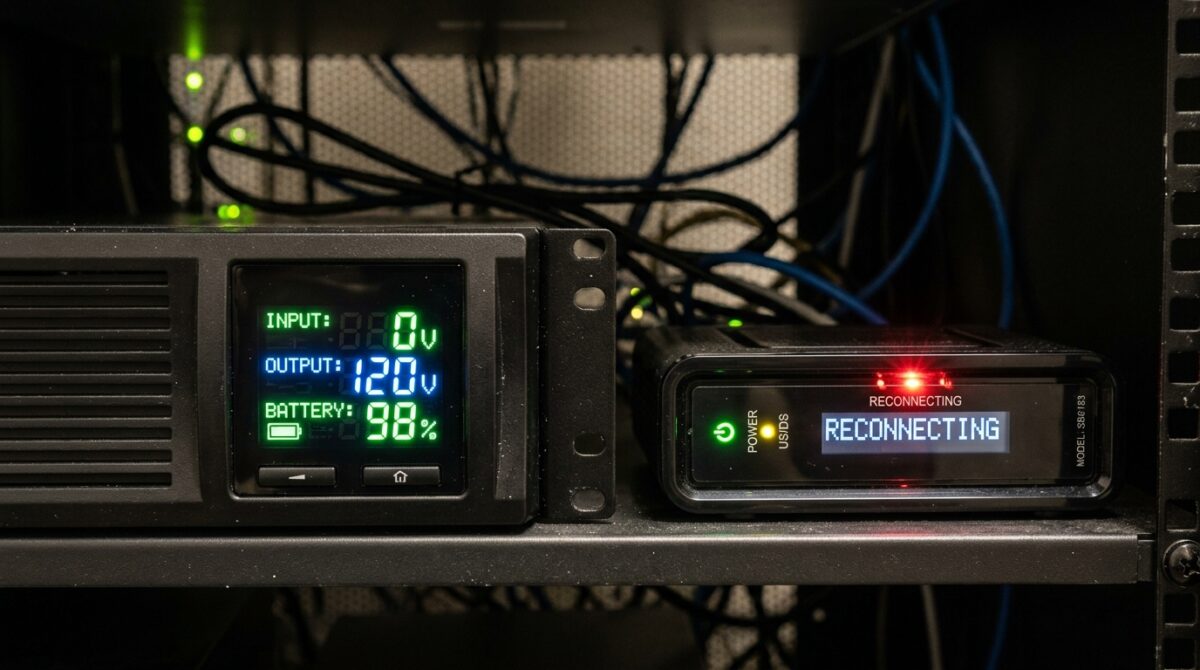
Uninterruptible Power Supply (UPS) Transfer Time: Why Some Modems Reboot Despite Having Battery Backup
The usage of Uninterruptible Power Supplies, sometimes known as UPS systems, is widespread in order to safeguard electronic devices, including as computers, networking equipment, and smart gadgets, from unexpected power disruptions. Many customers are under the impression that connecting a modem or router to a UPS would ensure that they will have continuous access to the internet in the event of an electricity outage. Despite the fact that the UPS battery is operational and delivering backup energy, some modems and networking equipment continue to restart when the main power supply fails. Numerous factors, including transmission time, variations in power waveform, device sensitivity, and the modem’s own internal power architecture, are often responsible for this phenomenon. By gaining an understanding of how UPS switching works, one may get an understanding of why a product that has battery protection might nevertheless have a momentary shutdown.
The Workings of the UPS Transfer Time
There is no guarantee that a UPS will always provide continuous battery power. There are several consumer UPS versions that function by allowing regular wall energy to flow through the device until a power breakdown has place. When there is a disruption in the supply of power, the uninterruptible power supply (UPS) is able to detect it and move the load from the utility power to the battery power. In a matter of milliseconds, this change takes place; however, the precise time is dependent upon the UPS architecture. There is a possibility that linked devices may notice a momentary decline in power during this brief time of transition. Although a large number of computers are able to survive this short interruption, some networking equipment that is particularly sensitive may restart.
Which UPS Types Are Different From One Another
The manner in which uninterruptible power supply (UPS) systems manage power switching is the primary factor that differentiates them into several types. Standby uninterruptible power supply (UPS) types often only deliver battery power after detecting a power breakdown, which results in a little delay in the transmission of power. Online UPS systems constantly convert incoming power and give a steady output without the need for a typical transfer event, but line-interactive UPS systems increase regulation and often provide quicker transitions. Also, online UPS systems are more efficient. When there is a power loss, the kind of UPS that is being utilized might have a direct impact on whether or not a modem is forced to restart. UPS designs that decrease interruption time are often beneficial for products that have power needs that are more sensitive.
The Reasons Why Modems Are Dependent on Power Gaps
Both modems and routers include internal processors, memory systems, wireless radios, and other components used for network connection. These devices need consistent electrical power in order to function properly. It is possible for networking equipment to restart if the power supply drops below a specific threshold. This is in contrast to some devices, which are able to swiftly recover after experiencing a minor voltage drop. The internal circuits of the modem may be reset by anything from a very brief interruption to a much longer one. It is for this reason that a UPS is able to effectively maintain lights or basic electronics operating even when a modem abruptly disconnects and starts the process of going through a complete reboot.
What Function Do Internal Power Adapters Serve?
In the power chain, the UPS is only one component among several. The vast majority of modems and routers do not connect directly to the AC power supply of a home; rather, they make use of external power adapters that transform the energy into DC power at a lower voltage. Furthermore, these adapters are equipped with their very own filtering and regulating components. It is possible that the output waveform or voltage stability may undergo a momentary shift during a UPS transfer event, which will have an impact on the adapter’s performance. An adapter of higher quality may be able to manage the changeover without any problems, but an adapter of lower quality may not be able to sustain continuous output for a sufficient amount of time to keep the modem operational.
The compatibility of waveforms and the quality of power
Another element that might have an effect on the stability of a device when it is operating with a UPS is the power quality. When operating on battery power, many uninterruptible power supply (UPS) systems provide a “simulated sine wave” output rather than a “pure sine wave” signal. It is possible that some power supply may react adversely to variations in waveform, despite the fact that many devices work correctly with this sort of output source. It is possible for sensitive electronics to perceive these changes as unstable power circumstances, which might result in resets or behavior that is unanticipated. In certain cases, the problem is not the quantity of backup power that is available; rather, it is the quality and consistency of the energy that is really being provided.
Battery backup does not always mean that there will be no interruptions.
Under the assumption that a UPS supplies the same kind of power both before and after an outage, there is a widespread misconception. In any case, numerous uninterruptible power supply (UPS) systems are required to detect the failure, activate their inverter, and shift the load. This procedure generates a brief window of opportunity for linked devices to encounter altered electrical circumstances. In spite of the fact that the UPS battery may have sufficient capacity to power a modem for a considerable amount of time, the modem may still restart if the switching mechanism is not sufficiently quick or reliable. The length of the backup and the performance of the transfer are two distinct characteristics.
Specified Power Requirements for Network Equipment
Various networking devices have varying degrees of tolerance for potential abuse. It is possible that basic modems and routers may respond differently to short pauses depending on the hardware architecture of the device. Fiber network equipment, cable modems, and modern Wi-Fi systems often have a greater number of processing components and may be more susceptible to power instability. Even if the actual interruption was just a few seconds long, some devices will still undertake startup checks after identifying abnormal power conditions. This will cause the downtime to be much longer. To better understand why certain models continue to function online while others restart, it is helpful to have a better understanding of the individual power needs of networking devices.
A Guide to Minimizing Modem Reboots During Power Outages
By picking a UPS that is built for sensitive electronics and networking equipment, users may increase the dependability of their electrical systems. When it comes to protection, a UPS that has a quicker transfer time and cleaner battery output is typically considered to be superior. Because the adapter has a direct impact on how well the device manages power changes, it is also crucial to choose a power adapter that is of high quality for the modem. Maintaining the condition of the UPS battery guarantees that it will be able to react swiftly in the event of power interruptions. Another factor that contributes to more steady functioning is ensuring that cable connections are correct and avoids overloading UPS outlets.
The Necessity of Conducting Tests on Your Backup Configuration
Many individuals may not become aware of UPS compatibility difficulties until after a power outage has already occurred. When users test the system under controlled settings, they are able to determine whether or not the modem continues to function even after the UPS changes to battery mode. It is possible to determine if the transfer time is adequate for the connected equipment by performing a simple power interruption test. Testing on a regular basis is particularly crucial for customers who rely on internet connectivity for distant work, security systems, or communication during power outages.
When it comes to network reliability, selecting the appropriate UPS
Although an uninterruptible power supply (UPS) may provide wonderful protection for routers and modems, not all models offer the same level of performance. Whether or whether the connection is still operational during an outage is contingent upon a number of factors, including the transfer time, output quality, compatibility of the power adapter, and the sensitivity of the device. The failure of the UPS is not always the cause of a modem reboot; rather, it may be an indication that the power transfer was not smooth enough for that specific device. By choosing a suitable kind of uninterruptible power supply (UPS) and gaining a knowledge of how power distribution works, users are able to construct a backup system that is more dependable and maintains the operation of important networking equipment under unpredictable electrical conditions.