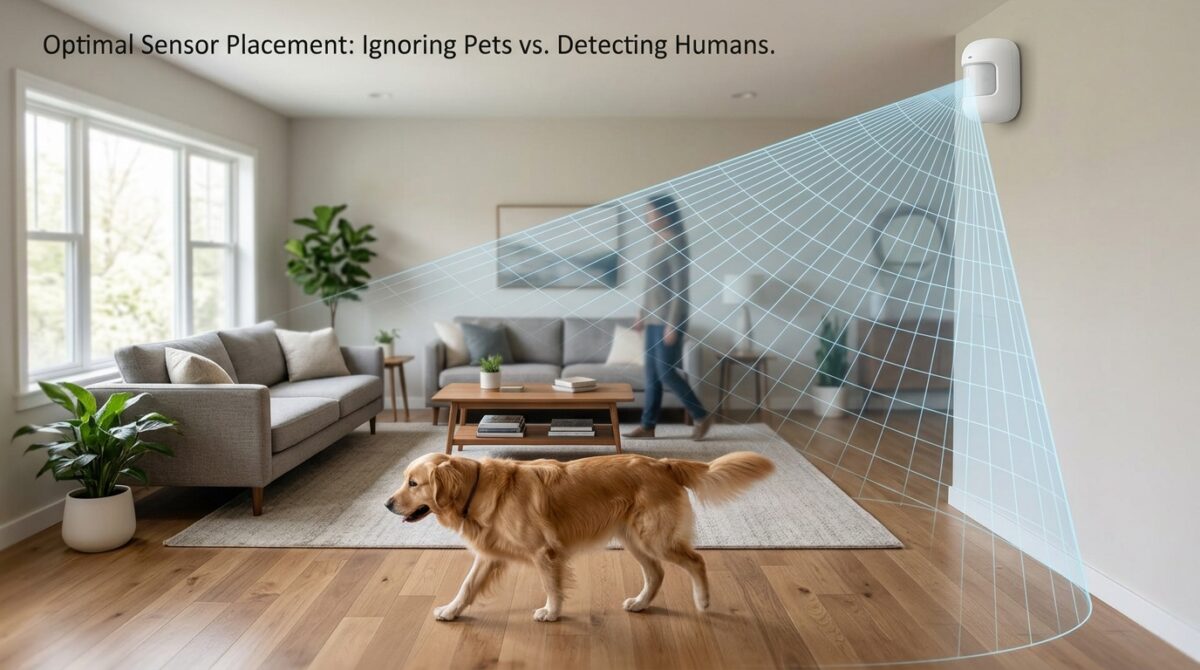
How to Position Smart Home Motion Sensors to Ignore Large Pets Without Compromising Security Triggers
Providing automatic warnings, lighting control, and intelligent home monitoring, smart home motion sensors have become an essential component of contemporary security systems during the last several years. On the other hand, homes who have big dogs often confront a similar difficulty, which is the prevention of false alarms without simultaneously diminishing the efficiency of security detection. At the same time as a motion sensor that responds each time a dog or cat walks across the room may soon become aggravating, a sensor that is improperly positioned may fail to detect actual human movement. To achieve the optimal equilibrium, it is necessary to have a grasp of how motion sensors detect movement, how dogs interact with detecting zones, and how placement impacts the accuracy of the detection. It is possible for homeowners to limit the number of unneeded warnings while still retaining effective protection against unauthorized entry if they properly set and configure their security systems.
Recognizing the Process by Which Intelligent Motion Sensors Detect Movement
The majority of intelligent motion sensors depend on passive infrared technology, which is more generally referred to as PIR, in order to identify variations in the heat patterns that are present within its viewing region. These sensors do not observe things in the same way that a camera does; rather, they monitor the infrared radiation that is generated by warm bodies as they wander across a region. In the case that a human or animal passes within the detecting zone, the sensor will detect any changes in the distribution of heat and will bring about an event. Due to the fact that both people and animals produce heat, the sensor is unable to automatically determine whether the movement is coming from a person or an animal. Therefore, modifications to placement and sensitivity play a significant part in the process of significantly enhancing detection accuracy.
The Reasons Why Large Pets Can Cause False Triggers
Because of their larger body size and higher heat production, large dogs are more likely to trigger motion sensors. This is because their movement patterns are more similar to those of humans. Because of their size, bigger dogs are able to access the same infrared zones that detect humans, whereas smaller animals that move close to the ground may stay outside of the sensor’s detection range. It is possible to generate powerful signals that are similar to human activity by performing actions such as leaping onto furniture, moving quickly, or walking straight across the field of view of the sensor. When a sensor is not properly positioned in a house that has pets that are active, it has the potential to produce several false alerts throughout the day, which causes the whole security system to be less reliable.
The Significance of Positioning Sensors at a Right Height
To limit the number of triggers that are associated with pets, sensor height is one of the most efficient methods. Because this generates a detection angle that is suited for human movement, many motion sensors are intended to be put higher on walls, often several feet above the floor. This is necessary in order to achieve optimal performance. Homeowners may establish a detection area that prioritizes human movement while reducing low-level pet activity by placing sensors at the suggested height and angling them slightly lower. This allows the homeowners to create safer environments for their pets. The placement of sensors at an inappropriately low level increases the likelihood that pets will occupy the most powerful detection zones, which will result in the activation of warnings that are not essential.
You may get an advantage by using detection angles.
Along with its height, the direction that a sensor faces is also a significant consideration. There is a common tendency for PIR sensors to be more sensitive to movement that is passing over their field of vision as opposed to movement that is straight approaching them. It is possible to increase human detection by positioning a sensor in such a manner that it crosses the detection pattern when people are traveling through doors or hallways. On the other hand, limiting direct views of pet paths, feeding locations, beds, and regular animal routes might help minimize the number of false triggers that occur. It is possible for the sensor to concentrate on significant access points by using strategic angles, rather than continuously monitoring regions where dogs spend the majority of their time.
Avoiding the Most Frequent Errors in Placement
Installation decisions, rather than sensor constraints, are the source of many difficulties with motion sensors. It is possible to produce unforeseen changes that interfere with detection by positioning sensors in close proximity to heating vents, windows that are exposed to direct sunlight, moving curtains, or sources of air circulation. The placement of sensors in locations where animals commonly leap, such as stairs, furniture that dogs climb on, or areas where animals frequently jump, may also increase the number of false alarms. Installation of sensors in surroundings that are stable and provide clear views of significant movement pathways results in an improvement in the performance of security measures. It is frequently the case that boosting the sensitivity settings alone does not provide the same effects as properly selecting the place.
The Modification of Sensitivity and Immunity Features for Pets
A significant number of contemporary motion sensors are equipped with pet-immunity settings or sensitivity levels that can be adjusted, making them ideal for households that include animals. Users are able to limit the detection of minor movements while preserving a better reaction to bigger objects thanks to these options for their devices. However, pet immunity is not a foolproof solution since it is contingent on the size and weight of the animal, the movement patterns of the animal, and the design of the sensor. Even with pet filtering turned on, it is possible for a really big dog to still send off some alarms. When it comes to producing superior outcomes, it is often more effective to combine sensitivity changes with optimal physical positioning rather than depending just on software settings.
What You Need to Know About the Boundaries of Pet-Friendly Detection
Having motion detection that is pet-friendly does not imply that the sensor fully disregards animals. Instead, it lessens the possibility of detecting movement that is less than a certain size threshold. If a huge pet is standing straight, moving swiftly, or approaching from particular angles, it is still possible to identify a considerable shift in temperature. There must be a balance between the elimination of false alarms and the detection of human activity that is dependable. If the sensitivity is decreased in an excessively aggressive manner, there is a possibility that a person entering the house may not cause an alarm to go off in a timely manner. The objective is not to completely eradicate the detection of pets but rather to fully optimize the sensor environment.
Utilizing a Number of Sensors in Order to Improve Coverage
It is possible that a single motion sensor will not give enough coverage in a house that allows pets. The use of several sensors gives homeowners the ability to split their areas into detection zones that are more tightly regulated. As an example, one sensor may be in charge of monitoring an entry area, while another sensor can cover a corridor or a restricted space. There is less of a requirement for a single device to monitor an entire open area where dogs constantly walk about thanks to this strategy. By carefully positioning many sensors, it is possible to enhance overall security while also enabling individual devices to function with settings that are appropriate for their respective locations.
Utilizing Motion Sensors in Conjunction with Other Intelligent Security Machines
It is common practice for contemporary intelligent security systems to include motion sensors, cameras, door sensors, window sensors, and automation rules. Due to the fact that no single device is responsible for detecting every single sort of activity, this layered approach enhances dependability. A motion sensor may be responsible for initiating an initial event, but a camera system may provide visual confirmation or an extra verification step. The combination of technologies lessens the effect of false triggers brought on by pets while also maintaining a high level of security coverage. It is also possible for intelligent automation to generate schedules or rules that modify monitoring behavior in accordance with the routines used in the home.
Establishing a Dependable Security System That Is Friendly to Pets
The most successful smart home security system for pet owners comes from combining good location, right sensitivity levels, and reasonable expectations. Installing motion sensors at a height that is high enough to limit low-level pet movement, aiming them toward vital human paths, and adjusting them according to the size and behavior of household animals are all great ideas. In order to further increase dependability, it is possible to avoid frequent environmental difficulties and to use several detection techniques. Even while there is no motion sensor that can accurately differentiate between every human and every pet, homeowners may greatly limit the number of false alerts without compromising their level of safety by carefully configuring their security systems. A well-designed system gives both ease for everyday life and assurance that significant behavior will still be identified when it counts.