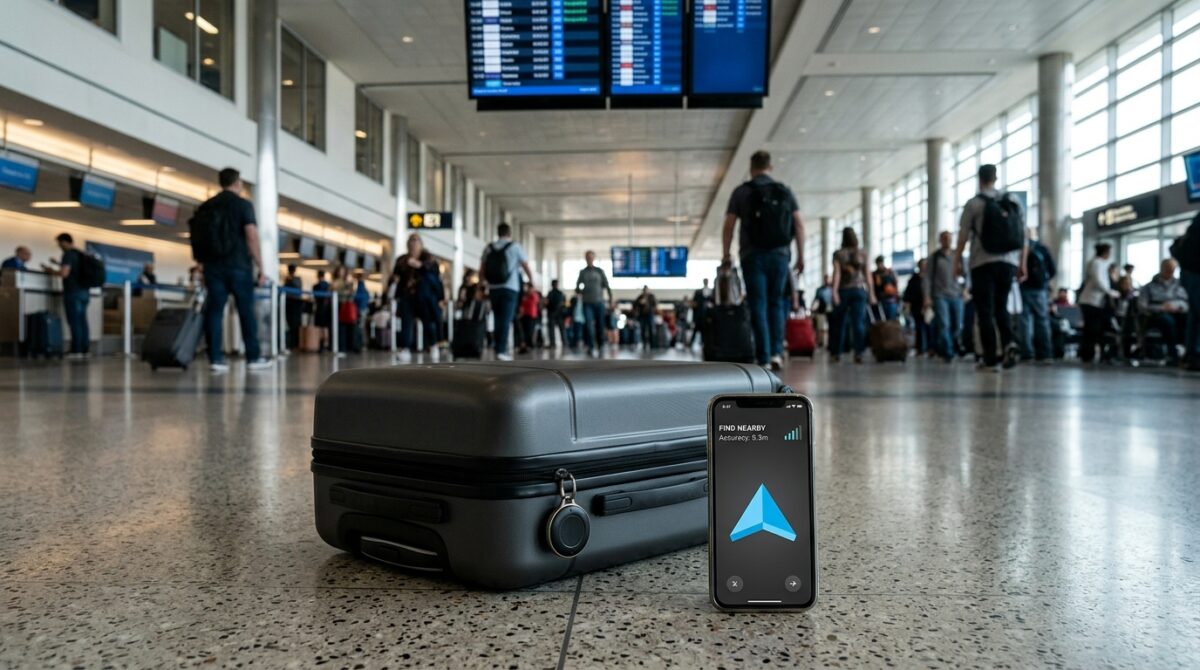
Smart Luggage Trackers: Ultra-Wideband (UWB) vs Standard Bluetooth Accuracy in Dense Airport Terminals
Luggage monitoring is one area in which innovation has dramatically enhanced the passenger experience. Since the advent of technology, air travel has been more reliant on technology. Concerns about lost, delayed, and misdirected luggage continue to be widespread among passengers, especially when traversing big international airports that have several terminals and sophisticated baggage handling systems. Travelers now have the ability to monitor the position of their baggage directly from their cellphones thanks to the development of smart luggage trackers, which have emerged as a practical option. While the majority of early tracking devices depended only on Bluetooth technology, more recent products are increasingly using Ultra-Wideband, also known as UWB, in order to provide positional information that is more accurate. Despite the fact that both systems are capable of assisting in the location of baggage, their performance in busy airport settings is quite drastically different. If passengers are able to get an understanding of the accuracy, limits, and behavior of UWB and Bluetooth tracking devices in the real world, they will be better equipped to choose the most efficient approach for identifying luggage in complex airport terminals.
Gaining an Understanding of the Operation of Bluetooth Luggage Tracking
Low-power wireless signals are sent by baggage trackers that are based on Bluetooth technology. These signals may be received by adjacent devices that are compatible with the technology. When the tracker is detected by another device, the owner is provided with the location information that is sent over a network infrastructure and made accessible to them. Trackers are able to function well while requiring a small amount of battery power because to this strategy. When baggage is placed within a reasonably narrow region, Bluetooth technology performs very well in terms of giving general location awareness while also working especially effectively in this regard. Bluetooth signals, on the other hand, were not constructed with the intention of providing very accurate localization. Bluetooth monitoring often delivers an estimated location rather than an actual physical position in airports that are very busy and include thousands of people, electronic gadgets, and wireless signals.
The Distinctive Characteristics of Ultra-Wideband
Unlike other technologies, ultra-wideband technology takes a fundamentally different approach to the tracking of locations. Instead of depending mostly on estimations of signal strength, UWB focuses on measuring the exact amount of time that radio signals take to travel from one device to another. Because of this, compatible systems are able to compute distance and directional information with a substantially higher degree of precision. Not only is it possible for UWB to estimate the distance between an object and its location, but it can also do it in a specified direction. This functionality shifts the user experience from generic tracking to spatial guiding in a manner that is almost real-time. Increased accuracy may make the process of identifying luggage much quicker and more natural for passengers who are browsing through congested baggage claim areas or traversing busy airports.
Airport environments that are densely populated provide a number of challenges.
The setting that airports provide to wireless positioning technology is one of the most difficult places to work in. There are a lot of factors that may impede the transmission of signals, including large numbers of people, metal structures, moving vehicles, baggage containers, electrical equipment, and architectural obstructions. It is not uncommon for terminals and baggage handling facilities to have wireless reflections and signal attenuation. It is common for Bluetooth trackers to have difficulties in these situations due to the fact that the signal strength might change significantly depending on the barriers that are present. Putting a tracker behind many pieces of baggage might make it look as if it is farther away than it really is. Dense settings provide factors that may impair the precision of locating and make it more difficult to locate a single bag amid hundreds of things that are nearby.
Accuracy of Bluetooth in Real-World Terminal Conditions at the Terminal
Instead of providing precise tracking, Bluetooth trackers often give location awareness at the level of the room or the region in which they are located in real airport circumstances. It is possible for a passenger to get notification that a bag found inside a certain baggage claim area, terminal sector, or neighboring zone has been located. This information is helpful for establishing that baggage has arrived at the airport of destination and is still within a general region of the airport. Visual searching may still be necessary in order to locate a particular bag amid a large number of luggage that are identical to one another. When exact item identification is required in congested settings that include a large number of physical impediments and competing wireless signals, Bluetooth’s performance may be satisfactory for broad tracking purposes; but, it becomes less successful when specific item identification is required.
Performance of the UWB Systems in Congested Baggage Areas
When it comes to providing passengers with accurate positional information, ultra-wideband technology provides a substantial advantage. Users are often able to obtain extremely accurate advice toward the precise position of a monitored bag. This is due to the fact that UWB calculates distance and direction with a significantly better degree of accuracy. In ecosystems that they are compatible with, cellphones have the ability to show directional cues that take users straight to the object itself. It is especially helpful to have this feature in baggage claim areas that are crowded and have a large number of items of luggage clustered together in close proximity to one another. Instead of checking the whole carousel or waiting area, visitors may more effectively identify the particular position of their luggage instead of having to search the entire area. When compared to conventional tracking systems that rely only on Bluetooth, the end result is a retrieval experience that is both quicker and more accurate.
Reliability of Signals in the Area Around Metal Structures
There is a significant amount of metal infrastructure present in airport surroundings. This infrastructure includes conveyor systems, luggage carts, security apparatus, seating structures, and building frames. Surfaces made of metal have the ability to reflect, absorb, and modify wireless signals. Under these circumstances, Bluetooth trackers often encounter decreased consistency. This is due to the fact that position predictions are strongly dependent on information about signal strength assessments. UWB technology is typically more robust than other technologies since it places more of an emphasis on exact timing calculations as opposed to depending only on signal strength. When operating near complex buildings, which are generally present throughout contemporary airport facilities, UWB typically maintains superior positioning accuracy than other wireless technologies. This is despite the fact that no wireless technology is totally immune to interference created by the environment.
Efficiency of Batteries and the Trade-Offs involved in Operation
For baggage trackers, battery performance continues to be a crucial factor, despite the fact that accuracy is also vital. It is possible for Bluetooth technology to function for lengthy periods of time without the need to replace or recharge the battery. Bluetooth technology is incredibly power efficient. As a result of its low energy usage, it has become more popular in the travel accessory market. Although UWB systems provide improved accuracy, they may have a higher power consumption depending on the implementation and use patterns of the system. A common method that manufacturers use to strike a balance between these trade-offs is to include numerous technologies into a single tracker. It is possible for hybrid designs to make use of Bluetooth for general location awareness, while only activating UWB characteristics when it is essential to provide accurate positioning capabilities. Utilizing this strategy helps to prolong the life of the battery while also giving improved tracking capabilities.
Taking into Account the Compatibility of Devices
Device compatibility is a factor that plays a role in the efficacy of high-tech tracking devices. The functionality of Bluetooth is essentially uniform across all current smartphones and linked gadgets, which makes it accessible to a wide variety of consumers. UWB support, on the other hand, is presently only accessible on a limited number of smartphone models and ecosystems for devices. Before making a purchase, travelers who are contemplating acquiring UWB-enabled baggage trackers should make sure that they are compatible. Users may not be able to take use of the full accuracy capabilities that UWB technology has to offer if they do not have a device that is compatible with it. There is a good chance that compatibility limits may decrease as usage continues to grow; yet, they continue to be an essential consideration when considering tracking systems in the present day.
How to Determine Which Tracker Is the Best for Airport Travel
When it comes to smart baggage trackers that are designed for use in busy airport terminals, Bluetooth and Ultra-Wideband both provide significant advantages; yet, they are used for quite different reasons. Wireless Bluetooth technology offers dependable general location awareness, exceptional battery economy, and extensive interoperability across a wide range of devices. When it comes to authenticating the existence of baggage and determining its approximate position during the travel process, it is a very successful method. Using these characteristics as a foundation, Ultra-Wideband is able to provide much improved positioning precision and directional guidance, which makes it much simpler to detect particular bags in busy areas. UWB provides a significant benefit to passengers who often traverse crowded airports and place a high priority on the accurate recovery of their luggage because of this. The Ultra-Wideband technology provides the next level in baggage tracking precision, delivering a more refined and efficient experience in complicated airport environments. Bluetooth continues to be a viable and practical option, but Ultra-Wideband represents the next step.