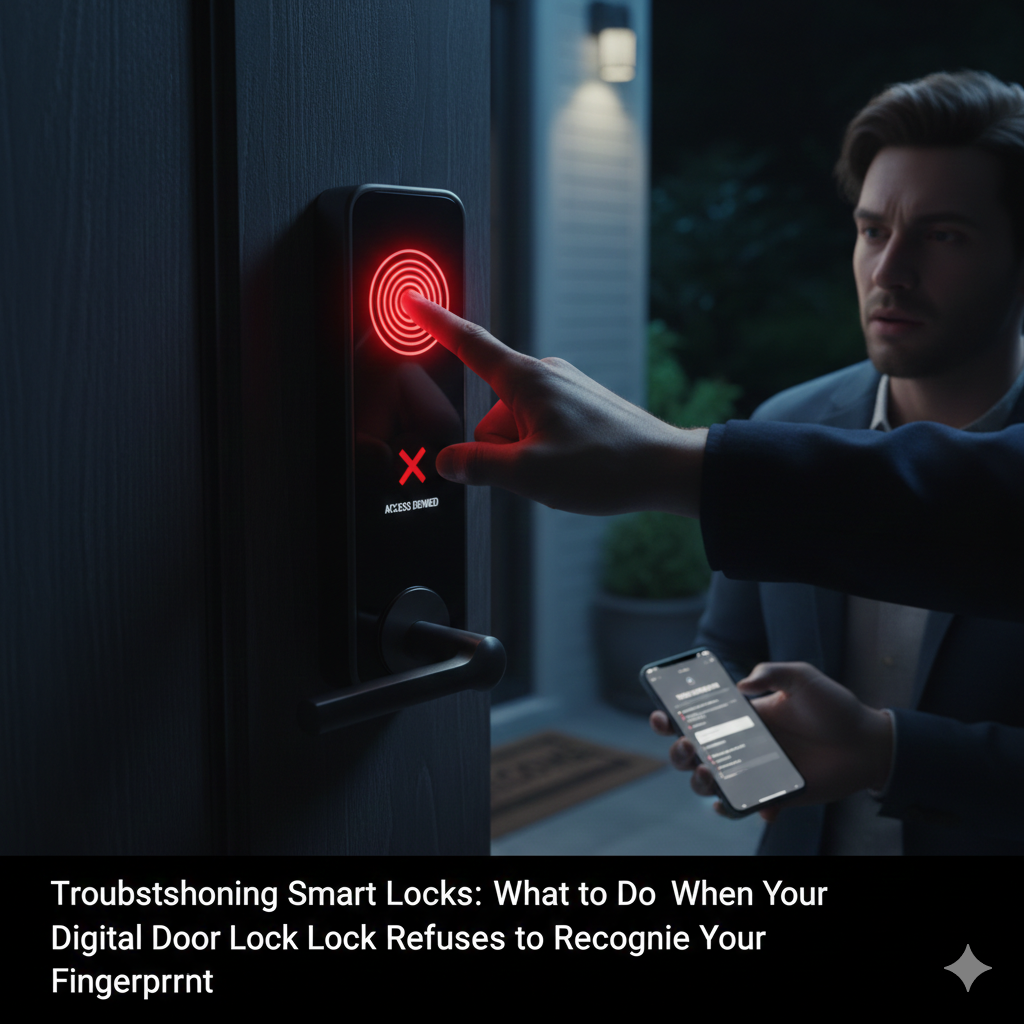
Troubleshooting Smart Locks: What to Do When Your Digital Door Lock Refuses to Recognize Your Fingerprint
In the year 2026, smart locks provide convenience, security, and keyless access; yet, even the most modern fingerprint-based devices may have difficulties with identification. In the event that a digital door lock does not register or identify your fingerprint, it may be quite annoying and may even result in you being locked out of your home. It is more common for environmental conditions, sensor contamination, or software calibration errors to be the root cause of these problems than it is for hardware failure to be the reason. In order to guarantee dependable access while preserving the lock’s functionality and security, it is necessary to have an understanding of the reasons why fingerprint sensors fail and to be familiar with safe troubleshooting techniques. For the most part, recognition issues may be rapidly rectified without the need for professional involvement if careful attention is paid to them.
Fixing the fingerprint sensor that is dirty
Having a sensor that is filthy or occluded is the most prevalent reason for a failed recognition attempt. Fingerprint sensors are sensitive to a variety of contaminants, including oils, dust, moisture, and residue from lotions or dirt embedded on the finger. The surface of the sensor should be carefully wiped off with a microfiber cloth that is lint-free and gentle. Avoid using severe chemicals or materials that are abrasive, since they might potentially scratch the sensor. Cleaning the scanning area on a regular basis helps to maintain its clarity, which in turn ensures accurate readings and extends the life of the fingerprint module.
Evaluation of the Condition of Your Fingers
Not only that, but your own finger may also impair recognition. The capacity of the sensor to match the recorded pattern might be hindered by skin conditions such as cuts, scars, filth, or extreme dryness. There is a possibility that the sensor will read more accurately if you warm up chilly fingers or mildly wet dry skin. Additionally, it is beneficial to re-register your fingerprint on a regular basis, particularly if the texture of your skin changes over time or if you have sustained minor injuries. For the purpose of enhancing the level of dependability, some smart locks enable the storage of several fingerprints for a single user.
It is possible to power cycle or restart the lock.
There is a possibility that software bugs may prohibit sensors from operating accordingly. Rebooting the smart lock for a short period of time or removing and replacing the battery are two common solutions that may fix these small software glitches. Certain kinds of locks that are connected with Wi-Fi or Bluetooth need an active connection in order to verify fingerprints or carry out authentication checks. Therefore, it is important to guarantee that the communication is stable. The system can be refreshed, the sensor can be recalibrated, and the identification accuracy can be restored with only a simple restart.
Adjusting the Parameters of the Fingerprint Sensor
It is possible that the sensor has to be recalibrated if cleaning and restarting it do not work. Many contemporary smart locks come with a mobile app or an onboard menu that allows users to adjust the sensitivity or calibration of the lock. Recalibration may be improved by modifying the sensor’s tolerance to finger pressure, angle, and location. This can be accomplished by following the instructions provided by the manufacturer. Recalibration is especially helpful in locks that see high levels of traffic or after environmental changes that have an impact on the operation of sensors.
Bringing Software and Firmware Up to Date
Updated firmware or companion applications have the potential to create faults or impair the accuracy of sensors. Install any firmware upgrades that are available via the lock’s official interface or through the app, and be sure to do so as directed. Improvements to fingerprint algorithms, enhanced sensor tolerance, and bug fixes that increase identification reliability are often included in updates. By staying up to date, you can guarantee that your smart lock performs at its best and prevent problems that are caused by software that is out of date.
Considerations Regarding the Environment
The determination of fingerprints may be affected by factors such as temperature, humidity, and lighting conditions. Both the sensor electronics and your finger may be affected by conditions that are either very cold or extremely hot. There are a number of factors that might impede scanning, including excessive moisture, fog, or bright sunshine. Maintaining constant performance may be facilitated by strategically positioning the lock in a protected area or by including environmental protection measures. With an understanding of these elements, it is possible to avoid making troubleshooting efforts that are not essential when circumstances are momentarily influencing recognition.
Creating a new fingerprint registration
There are situations when a simple deletion and re-registration of fingerprints has the ability to overcome recognition difficulties. You should make sure that the finger is put at a variety of angles and pressures throughout the re-registration process so that you can construct a thorough template. It is wise to refrain from continually utilizing worn fingerprints without making any alterations, since even little variations in skin texture might result in mismatches. Increasing overall dependability and decreasing the number of erroneous rejections may be accomplished by ensuring that each finger is registered accurately in homes that have many users.
Inquiring with Support or Taking into Consideration Hardware Problems
In the event that all of the troubleshooting methods are unsuccessful, the sensor may have a hardware mistake, such as a broken reader or a problem with the wiring. To get diagnostics, repair, or replacement alternatives, you should get in touch with the manufacturer’s support team in such a scenario. Numerous smart locks have modular sensors or battery replacement kits, which are able to overcome difficulties with recognition that persist over time. Lockouts may be avoided with prompt care, which also helps to preserve the security and usefulness of your domestic space.