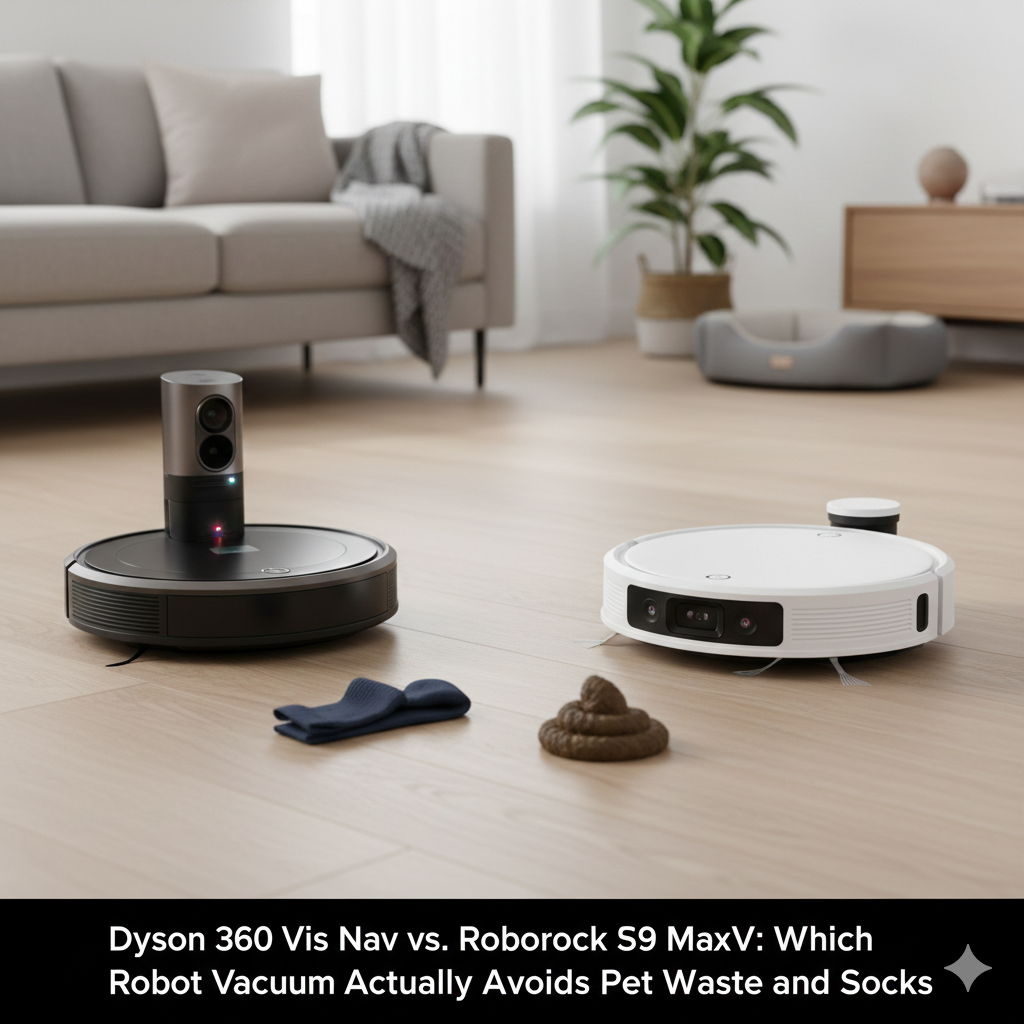
Dyson 360 Vis Nav vs. Roborock S9 MaxV: Which Robot Vacuum Actually Avoids Pet Waste and Socks?
In the year 2026, robot vacuums are no longer limited to cleaning dust and hair; rather, they are capable of autonomously handling real-world problems such as pet feces, socks, wires, and toys. In houses with dogs and hectic lives, the ability to avoid obstacles has become more vital than the ability to generate raw suction force. The Roborock S9 MaxV and the Dyson 360 Vis Nav are two of the most sophisticated models in this category. Both of these robots are touted as luxury cleaning robots that are driven by artificial intelligence. In spite of the fact that both claim to make use of sophisticated vision systems and machine learning, they approach navigation and object recognition in quite different ways. Instead of focusing on whether one is more effective at cleaning, the issue that has to be answered is which one genuinely avoids calamities such as spreading pet feces all over your floor.
Various Technologies for Mapping and Navigation
By using a complete 360-degree camera system in conjunction with SLAM-based visual mapping, the Dyson 360 Vis Nav offers a significant amount of reliance. By assessing visual landmarks and spatial elements, it creates a map of your area in real time, in a manner that is analogous to the way autonomous cars sense their surroundings. Because of this, Dyson is able to maneuver accurately even in intricate room layouts without having to depend on laser towers. The Roborock S9 MaxV is equipped with a hybrid system that combines LiDAR mapping with twin front cameras. This provides it with the ability to provide both visual identification and spatial depth. By using this dual-layer method, Roborock is able to generate floor maps that are incredibly precise while simultaneously gaining a grasp of the items that are in its path. Roborock has a tendency to be more consistent in terms of mapping accuracy in houses that are big or include several rooms.
A.I. Object Recognition System
The ability of the robot to detect things before it touches them is a significant factor in determining how successfully it can avoid obstacles. Through the analysis of its video feed, Dyson employs computer vision models that have been taught to recognize typical home things like as shoes, wires, bowls, and excrement from pets. Nevertheless, due to the fact that it is mostly dependent on a single vision system, its accuracy is contingent upon the different lighting conditions and camera angles. The S9 MaxV from Roborock is equipped with stereo cameras and infrared depth sensors, which enable it to recognize things even when there is a little amount of light. Consequently, Roborock is now more capable of accurately identifying irregular forms, such as socks or pet toys that are laying flat on the ground. Roborock’s artificial intelligence has a tendency to recognize impediments earlier and more consistently in surroundings mimicking the real world.
Effectiveness in the Avoidance of Pet Waste
The most difficult test for any intelligent robot vacuum is to clean up pet feces. However, in fact, Dyson’s artificial intelligence system has difficulty detecting and avoiding solid trash, particularly when it comes to garbage that is smaller or deeper in color, particularly on floors that are dark. Because it relies on visual cues rather than depth verification, it sometimes incorrectly categorizes objects or fails to recognize them until it is too late. Due to the fact that it has a multi-sensor fusion system that combines visual recognition with distance measurement, the S9 MaxV from Roborock has a far more reputable reputation in this particular domain. Because of this, it is able to recognize garbage, even before it comes into direct touch with it. Roborock unquestionably provides pet owners with a better level of confidence and a reduced level of danger.
Detection of Socks and Other Small Objects
In the world of robot vacuums, socks, cords, and charging wires are some of the most prevalent foes. However, thin wires and flat socks often fall beyond of Dyson’s reliable detection range, despite the fact that it is capable of detecting medium-sized items. Consequently, this may lead to brushes being tangled or goods being dragged across rooms. In particular, the twin camera system of Roborock is very effective at recognizing low-profile items, such as socks that are laying flat or partly concealed beneath furniture. Within the application, it is able to categorize these things and move around them with a greater degree of precision. Roborock is able to tolerate chaotic situations with more grace, making it ideal for families with children or houses that are cluttered.
An Intelligence Based on Real-World Cleaning
In addition to avoiding situations, smart conduct also involves being aware of where and how to clean in an effective manner. Dyson is a vacuum cleaner that focuses on high suction and direct airflow, and it modify its cleaning patterns depending on the amount of debris that it detects. It is particularly effective at deep carpet cleaning, although it sometimes compromises navigation stability in favor of sheer strength. Through the use of room-based cleaning zones and adaptive routing, Roborock strikes a balance between suction and strategic movement. As a consequence, there are fewer gaps in coverage and fewer instances of repeated motion. Roborock is more of a genuine autonomous system in its behavior, in contrast to Dyson, which seems more like a machine that is focused on performance.
AI Feedback and Control of Applications
In spite of the fact that it includes basic mapping, cleaning schedules, and item reporting, the Dyson app only provides a limited amount of information into what the robot really watches. In most cases, you won’t learn about hurdles until after the cleaning process has been completed. The software developed by Roborock displays visual representations of objects in real time, such as symbols for rubbish, wires, shoes, and socks. People are able to observe precisely what the robot avoided and where it avoided it. In addition to fostering trust, this openness enables a greater degree of control over cleaning behavior. The software ecosystem that Roborock offers seems to be more developed and data-driven.
Unwavering dependability in dimly light environments
A greater number of individuals are aware of the significance of lighting conditions. It is in well-lit surroundings that Dyson’s vision technology functions the best; nevertheless, it loses accuracy while cleaning in dimly lit rooms or during nighttime cleaning sessions. It is possible for shadows and dark surfaces to make object detection difficult. The infrared and depth sensors that Roborock has enable it to work efficiently even when it is almost completely dark. Because of this, it is better suited for uses such as midnight cleaning or cleaning in households with low natural light. When applied to situations that occur in the real world, Roborock is just more consistent across a variety of lighting conditions.
Final Decision for People Who Own Pets
There is little question that the Roborock S9 MaxV is the best option to go with if your primary concern is to steer clear of pet waste, socks, and other minor obstructions. Because of its multi-sensor artificial intelligence system, depth perception, and real-time item categorization, it is much more reliable in circumstances that are difficult to forecast. With its single-camera vision technology, the Dyson 360 Vis Nav is limited in its ability to perform well in complicated real-world scenarios, despite the fact that it has a remarkable suction and a unique design. For families and those who own pets, Roborock offers a decreased danger, improved navigation, and enhanced total autonomy, making it the robot vacuum that is both safer and more intelligent in the year 2026.