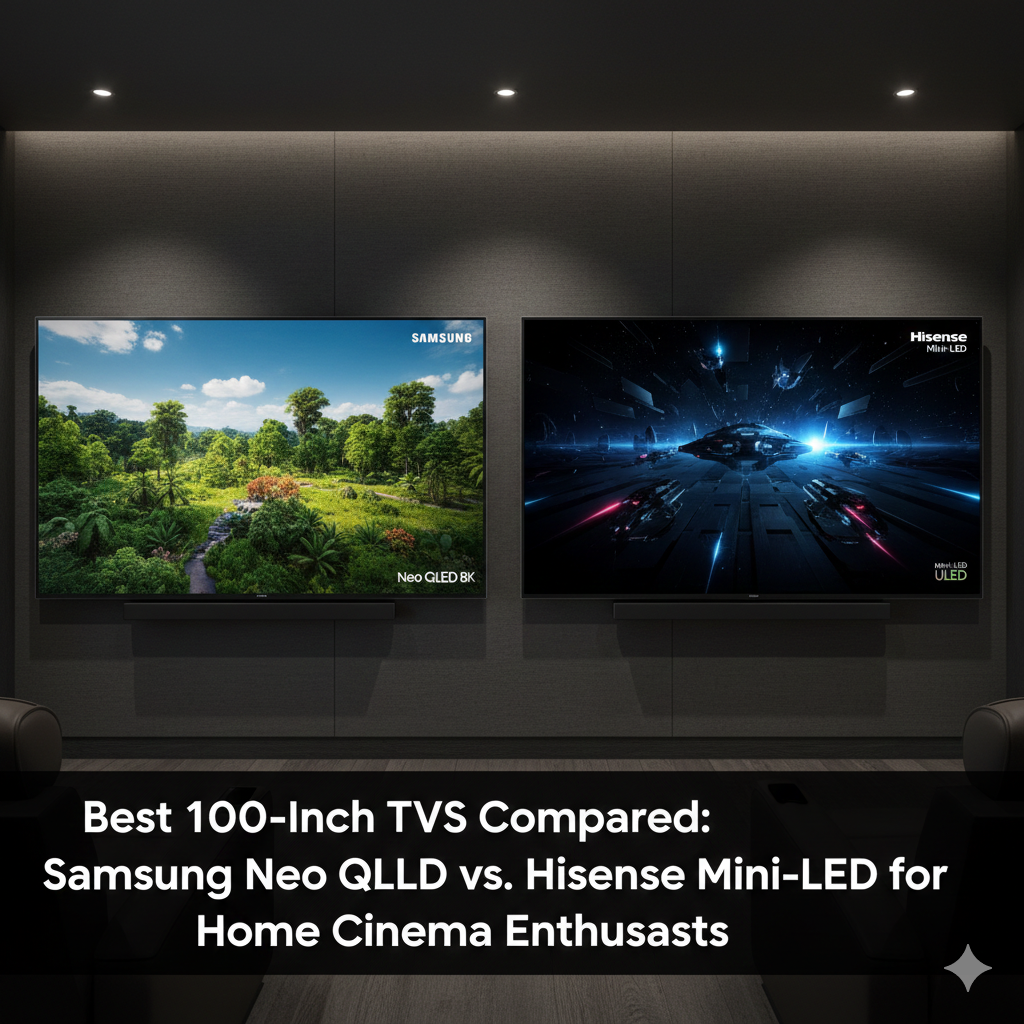
Best 100-Inch TVs Compared: Samsung Neo QLED vs. Hisense Mini-LED for Home Cinema Enthusiasts
Investing in a television with a screen size of one hundred inches for your home theater setup in the year 2026 is equivalent to purchasing one of the most immersive viewing experiences that can be had apart from projectors. The Neo QLED from Samsung and the Mini-LED from Hisense are two of the most advanced technologies in this sector. Both of these technologies produce pictures that are very vivid, detailed, and rich in contrast, making them ideal for use on big displays. In order to achieve higher contrast and more vibrant colors, Samsung’s Neo QLED lineup utilizes quantum dot layers in conjunction with a dense array of tiny LED backlights and advanced local dimming. On the other hand, Hisense’s Mini-LED panels make use of a large number of smaller LEDs with precise control zones in order to bring black levels and peak brightness closer to premium standards. When applied to a canvas of 100 inches in size, even minute variations in brightness uniformity, color correctness, motion management, and processing algorithms may have a significant impact on the pleasure of cinematographical experiences. Before committing to such a significant investment in your entertainment area, it is necessary for serious home theater fans to have a thorough grasp of how different technologies compare not just in terms of their headline specifications but also in terms of their performance in the real world.
Performance in terms of both picture quality and contrast
If you have a screen that is 100 inches in size, the picture quality is dependent on contrast, color accuracy, and uniformity. Quantum dot enhancement and a full-array micro backlight with very precise local dimming zones are used by Samsung’s Neo QLED display in order to provide deep blacks and rich colors throughout the screen. Consequently, this results in exceptional shadow detail as well as HDR highlights that are brilliant and punchy, and they maintain their saturation even when the brightest levels are present. Due to its tightly packed LEDs and properly controlled dimming zones, Hisense Mini-LED also provides a high level of contrast; but, when compared to Samsung’s quantum dot processing, it often lags somewhat behind in terms of color volume. Both devices function wonderfully in very dark settings; however, Samsung has a tendency to control blooming and halo effects more successfully, which results in smoother transitions between bright and dark areas on the wide screen.
Lighting and High Dynamic Range Performance
On a panel that is 100 inches in size, peak brightness and the ability to support high dynamic range (HDR) become essential for producing striking highlights in movies and sports. Spectral highlights in high dynamic range (HDR) content are able to seem more realistic and dynamic when shown on Samsung Neo QLED panels, which are noted for generating some of the greatest sustained brightness levels in LED-based displays. extremely helpful in highly lit settings, where details might be obscured by ambient light, this approach is extremely advantageous. Additionally, the Hisense Mini-LED displays have a high peak brightness and a great high dynamic range (HDR) performance. However, they have a tendency to disperse brightness more uniformly rather than striving for very intense peaks. As a consequence of this, viewers who place a high value on dazzling HDR highlights and brilliant specular spots would choose Samsung’s approach, but viewers who appreciate balanced brightness and reliable panel performance might go toward Hisense.
Processing Precision and Accuracy of Color
It is very important for cinematic film to have precise color fidelity since erroneous colors might cause the director’s intended views to be altered. The Neo QLED from Samsung is advantageous because to its quantum dot layer, which not only makes the color gamut more expansive but also provides good coverage of professional color spaces. When combined with the sophisticated image processing capabilities of Samsung, this contributes to the accurate reproduction of colors over a broad spectrum of tones. Hisense Mini-LED has made major advancements in color processing, especially in more recent versions that offer extensive calibration options and support for a broad spectrum of colors. In general, Samsung has a competitive advantage when it comes to out-of-the-box accuracy and processing refinement. This is significant for enthusiasts who are looking for perfect colors without having to do substantial manual calibration.
Movement Control and the Performance of Gaming Consoles
It is common for home theater installations to fulfill many functions, including gaming and the presentation of fast-paced sports programming. In order to produce smooth frames and decrease judder without adding artifacts, Samsung’s Neo QLED makes use of technologically advanced motion processing and low input lag modes. Additionally, because of this, it is an excellent option for live sports broadcasts and console gaming. The Hisense Mini-LED likewise performs well in these areas, providing excellent motion clarity and rapid input times. However, some models may display slightly more interpolation artifacts when the motion enhancement settings are set to aggressive. The blend of motion handling and processing that Samsung offers tends to give it an advantage over other manufacturers for gamers that want both dramatic images and competitive responsiveness.
The Quality of the Sound and the Integrated Features
The quality of the image is the major concern of those who like watching movies at home, but the performance of the audio system also has an impact on immersion. Larger premium versions from Samsung often come equipped with object-tracking sound systems that include multi-channel virtualisation. These sound systems are able to fill big rooms more efficiently without the need for additional speakers. In general, Hisense Mini-LED sets provide high-quality audio that is built in and support for Dolby Atmos and DTS codecs. However, it is possible that these sets do not attain the same room-filling effect right out of the product packaging. Although there are still a lot of enthusiasts who use their 100-inch televisions in conjunction with specialist soundbars or surround systems, it is important to notice the difference in the performance of the onboard audio for those who are looking for all-in-one solutions.
The User Experience and Platforms for Smart Televisions
When it comes to content discovery and app responsiveness, smart TV software has an impact on day-to-day usage. Samsung’s Tizen platform offers a user experience that is both sleek and packed with features. It supports a wide range of streaming services, delivers tailored suggestions, and offers sophisticated voice control. Although it sometimes trails significantly in terms of responsiveness and content curation, Hisense’s platform, which is often based on a large third-party operating system, is comparable to this in terms of having an easy-to-use interface and a strong availability of applications. The polish and ecosystem maturity of Samsung’s software frequently give a more polished user experience than that of other platforms, despite the fact that both systems support key streaming protocols and AI-assisted image settings.
Take into consideration the design, construction, and installation
The design and installation of a 100-inch television are important since it dominates any room. It is common for Samsung Neo QLED models to have bezels that are very tiny and profiles that are elegant, which allows them to mix in with contemporary living spaces. In premium settings, their versatility is increased due to the fact that they are compatible with flush wall mounting and have solid supports. Even while Hisense Mini-LED displays provide designs that are comparable with those of other manufacturers, certain models may be somewhat thicker than others owing to heat management and increased backlighting layers. Although the simplicity of installation and aesthetic integration are both dependent on personal desire, mounting solutions that are compatible with the majority of home theaters are offered by both companies.
Value and Ownership Over the Long Term
At the end of the day, the decision between the Samsung Neo QLED and the Hisense Mini-LED at the 100-inch size comes down to value and the areas of performance that are most important to you. The fact that Samsung is the industry leader in terms of color performance, brightness, and software ecosystem justifies the company’s prices, which are normally higher. When compared to Samsung, Hisense often offers lower prices while still providing superior contrast, HDR handling, and feature sets that satisfy a large number of aficionados. The Neo QLED from Samsung is an appealing option for viewers who are looking for a premium smart TV experience that also provides the highest possible level of picture quality, color accuracy, and motion management. Hisense’s Mini-LED demonstrates that excellent performance does not necessarily demand flagship price, and it is ideal for those who are looking for a huge screen of 100 inches that offers good performance and a somewhat better value. Regardless of the circumstances, these technologies are the pinnacle of what large-format LCD screens are capable of providing in the year 2026. They make home theater setups more stunning and immersive than they have ever been before.