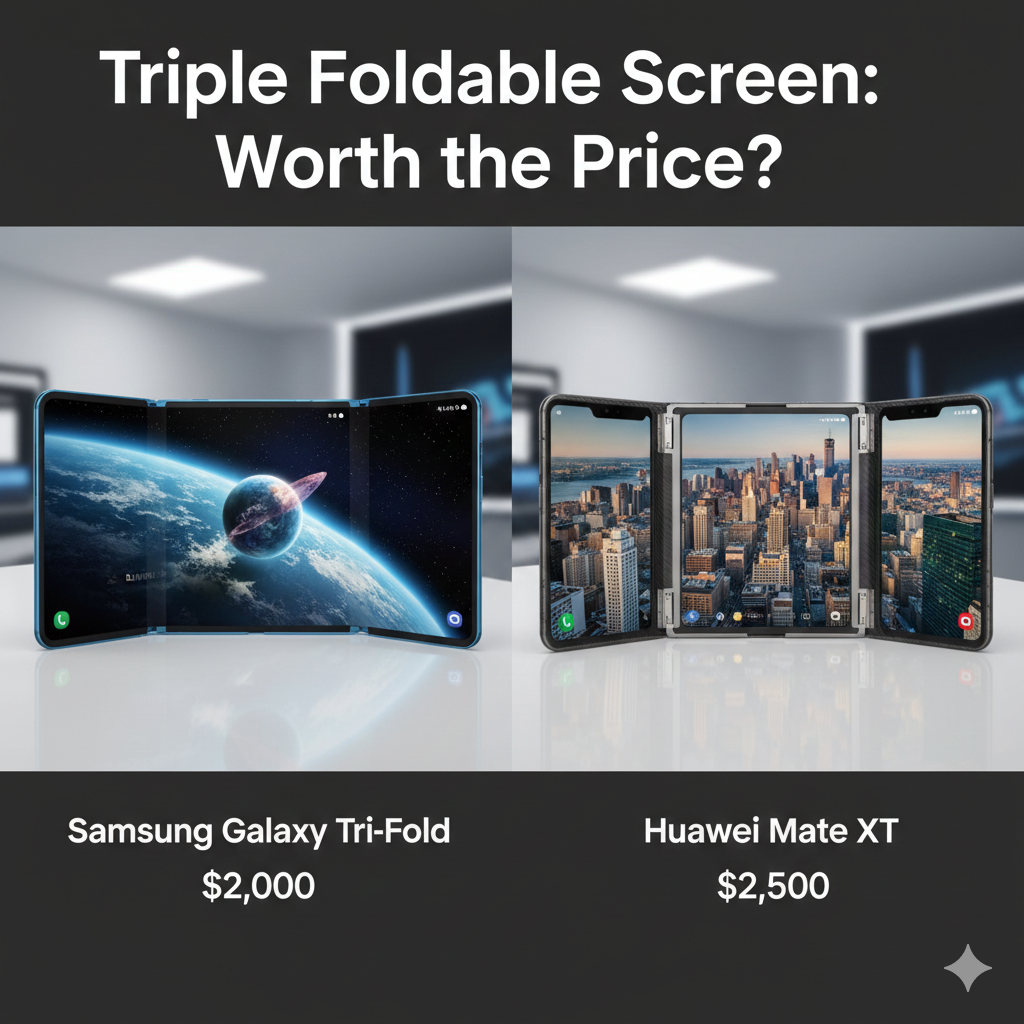
Samsung Galaxy Tri-Fold vs. Huawei Mate XT: Is the Triple Foldable Screen Worth the $2,500 Price Tag?
Foldable smartphones have progressed beyond basic book-style designs and are now approaching the age of triple-fold screens, which promise to replace both phones and tablets in a single device. These displays promise to make foldable smartphones more than just a book. The purpose of these gadgets is to provide users with a tiny form factor that, when necessary, may grow into a huge screen that can be used for productivity. The Samsung Galaxy Tri-Fold and the Huawei Mate XT are two smartphones that symbolize two distinct approaches to the desired appearance of the future. Premium consumers who are ready to pay a very high price for cutting-edge technology and experimental form factors are the target audience for both of these specialized gadgets. The issue that has to be answered, however, is whether or not this triple-fold notion provides sufficient value in the actual world to justify the expense of it. This choice is not only based on technical characteristics for the majority of consumers; rather, it is influenced by factors such as usability, durability, and practicality. The gadgets in question are no longer only mobile phones; rather, they include hybrid computer systems.
Quality of Design and Construction
The Samsung Galaxy Tri-Fold places a significant emphasis on durability and long-term usage. It makes use of stronger hinges and several layers of flexible glass to guarantee that the gadget can withstand numerous folding cycles. This is a reflection of Samsung’s expertise with past generations of foldable devices, which gives the whole design a more industrial and technical vibe. The Huawei Mate XT adopts a more understated and sophisticated approach, including smaller panels and better hinge transitions, which contribute to the device’s appearance of being further into the future. The thinner structure, on the other hand, leads to issues over the product’s tolerance to physical stress and its endurance over the long run. The one from Samsung has a more robust feel, whilst the one from Huawei has a more sophisticated feel. Samsung places a greater emphasis on dependability, whilst Huawei places a greater emphasis on aesthetic appeal. This distinction represents their respective agendas. When it comes to day-to-day usage, Samsung may seem more trustworthy to consumers who place a high importance on durability.
Experiences in Display Technology and Visual Display
Their triple-fold displays, which can morph from a standard phone screen into a big tablet-sized surface, are the primary selling points of both of these gadgets. As a result of Samsung’s use of cutting-edge OLED technology, which has great brightness and excellent color accuracy, the device is well suited for both professional and personal usage. Because of its lower bezels and smoother folding transitions, Huawei’s display is somewhat more immersive than those of its competitors. This is because the screen seems to be more continuous. High refresh rates are supported by both devices, which makes scrolling and multitasking operations more efficient. Despite this, there are still wrinkles that can be seen on both models, particularly when the light is coming from the front. Despite the fact that the experience is remarkable, it is not without the occasional glitch. Although the technology has a future feel to it, it is not yet as smooth as a conventional flat screen device.
Productivity Enhancing and Multitasking Capabilities
Generally speaking, triple-fold phones are built with productivity in mind, and both Samsung and Huawei place a significant emphasis on the possibilities of multitasking. It is possible for users to run three or more applications concurrently across various portions of the screen thanks to the software developed by Samsung. Because of this, it is ideal for doing work-related activities simultaneously, such as editing documents, sending emails, and participating in video conversations. Huawei provides capabilities that are comparable to those offered by competitors, but its user experience seems to be more experimental and less professional. In comparison to standard mobile devices, the bigger screen makes it easier to do many tasks at once. The majority of mobile applications, on the other hand, are not yet properly optimized for such broad layouts. Because of this, the amount of productivity that users may really gain is restricted. Despite the fact that the technology is prepared for the future, the software ecosystem is still playing catch-up.
Performance and the Power of the Hardware
Both of these devices are outfitted with high-performance CPUs, big quantities of random access memory (RAM), and high-speed storage, which guarantees a smooth performance even while engaged in demanding activities. The CPU that Samsung uses is geared for gaming and multitasking, which makes it more reliable when confronted with high workloads. Efficiency and artificial intelligence-based performance enhancements are the primary objectives of Huawei’s chipset. In day-to-day use, both gadgets have the sensation of being highly quick and responsive. On the other hand, when more than one application is running on such a huge display, heat management becomes very difficult. Heavy use over an extended period of time might cause a significant buildup of heat. When you put so much power into a body that is so tiny and foldable, this is the price you pay. The performance is outstanding, but it is not always possible to maintain it at top levels.
Lifespan of the Battery and the Charging Experience
As a result of the fact that bigger displays need a substantially higher amount of electricity, battery life is one of the most critical problems for triple-fold phones. In order to expand the amount of time that may be spent using the product, Samsung has included aggressive power management capabilities and a bigger battery capacity. In addition, Huawei makes use of a battery with a big capacity, although it is more dependent on rapid charging in order to compensate for its quicker loss. In real-world circumstances, both smartphones have difficulty lasting a whole day when extensive media consumption and multitasking are being performed on them. On the other hand, heavy users will need to recharge their batteries at least once a day, while light users could achieve an adequate battery life. Although it is helpful, rapid charging does not fix the fundamental problem of excessive energy use. This renders triple-fold phones less suitable for use during extended periods of travel or during workdays when there is no access to charging.
Portability and practicality for day-to-day use
Triple-fold phones, despite the fact that they have more modern technology, are nonetheless much heavier and thicker than conventional smartphones. Both of these gadgets are cumbersome when folded, and they may be difficult to carry in pockets. The design of the Samsung device is somewhat thicker but has a more substantial feel, whilst the design of the Huawei device is thinner but more delicate. In particular, users who choose lightweight phones will need to modify their routines in order to successfully carry these devices on a regular basis. Additionally, the process of opening and shutting the device several times during the day becomes a conscious movement. It is possible that this novelty will come to be an annoyance over time. The fact that they are remarkable does not mean that they are as simple to use as regular phones. When it comes to triple-fold technology, portability continues to be one of the most significant drawbacks.
The capacity to withstand wear and tear over time
When forking out such a substantial sum of money for a smartphone, durability is an essential consideration. The fact that Samsung has greater expertise with folding hinges and flexible screens offers them an edge when it comes to manufacturing dependability. Although Huawei’s design is cutting-edge, it has not yet been put through extensive testing in long-term use. There are significant issues about dust resistance, hinge wear, and screen fragility for each of these devices. The cost of repairs might be prohibitive even for relatively small damage. These gadgets, in contrast to conventional telephones, need for a far more cautious handling. The protective cases are restricted and often cumbersome. Because of this, triple-fold phones have the appearance of luxury goods rather than being utilitarian tools.
Value in Relation to Cost
Both gadgets have a price tag that is far more than that of even the most costly flagship smartphones, which is around $2,500. This price takes into account not just the cost of the gear, but also the cost of exploring new technologies and implementing them early on. It is not reasonable for the majority of consumers to justify such a significant pricing difference for the additional screen size. Tablets and traditional phones are already capable of doing the majority of activities well. Triple-fold smartphones provide a look into the future, but they are not necessary for people who use their phones on a daily basis. When it comes to value, inventiveness is more important than pragmatism. Rather of focusing on finding solutions to actual issues, these gadgets are designed to expose users to the next generation of technology.
The Conclusion Regarding Smartphones That Are Triple-Fold
A stage of mobile technology that is exciting but not yet fully developed is represented by triple-fold smartphones. While the Huawei Mate XT seems to be more modern and physically spectacular, the Samsung Galaxy Tri-Fold gives off the impression of being more dependable and practical. The mobility, battery life, and longevity of each of these gadgets are significantly compromised, despite the fact that they simultaneously give tremendous performance and beautiful displays. Those that are interested in technology and early adopters could find that the experience is worth the cost. For the majority of consumers, however, the advantages do not yet exceed the costs at this time. At this point in time, triple-fold phones are more of a luxury experiment than they are a useful practical daily technology. Not only does the technology show promise, but it is not yet required.