Thermal Paste Degradation in Old Laptops: When to Repaste vs When to Rely on Software Undervolting
The thermal behavior of a laptop has a significant impact on its performance over time, particularly as the device ages and its cooling efficiency steadily decreases. Thermal paste deterioration between the central processing unit (CPU) or graphics processing unit (GPU) and the heatsink is one of the most prevalent reasons of increasing temperatures in older laptops. The purpose of thermal paste is to promote heat transmission and fill tiny gaps; nevertheless, it gradually loses its conductivity, pumps out, or dries up over time when subjected to repeated heating cycles. As a consequence of this, customers often see greater temperatures while the system is idle, much louder fans, and thermal throttling under workloads that were previously steady. Two frequent remedies are discussed in this situation: physically repasting the central processing unit (CPU) and graphics processing unit (GPU), or performing software-based undervolting. The severity of thermal deterioration, the state of the hardware, and the stability of the system all play a role in determining which of these options to use.
The Degradation Process of Thermal Paste Over Time
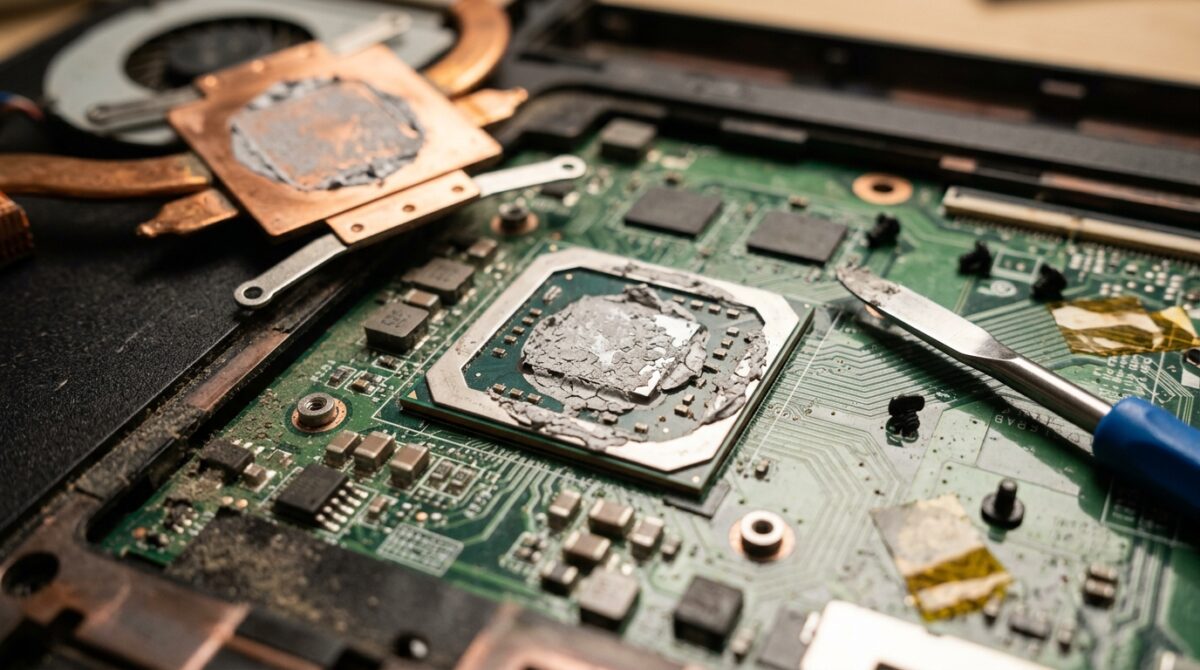
It is a thermally conductive material that facilitates effective heat transmission from the CPU to the cooling system. Thermal paste is a kind of thermal paste. It is possible that the paste could dry up or separate over time as a result of repeated cycles of heating and cooling, which would reduce its capacity to efficiently transfer heat. Laptops, with their more compact cooling systems and greater sustained temperatures, have the potential to speed up this process. When deterioration starts, the efficiency of heat transmission declines, which causes the central processing unit to operate hotter while maintaining the same workload. This causes the fan to behave in a more aggressive manner and causes thermal throttling to occur earlier.
Indications that Thermal Paste Is Not Working
Indicators of deteriorating thermal paste include temperatures that continuously rise for the central processing unit (CPU), unexpected decreases in performance when the system is under strain, and fans that spin at high speeds even while doing minor activities. Users could also see inconsistent thermal behavior, which is characterized by temperatures that quickly increase despite relatively low workloads. If the situation is serious, the laptop may see a significant decrease in performance within minutes of launching an application that is demanding. Having these symptoms indicates that the physical heat transfer mechanism is no longer effective, which may need intervention at the hardware level inside the system.
How the Physical Process of Repasting Restores the Efficiency of Cooling
One must first remove the cooling system of the laptop, then remove any old thermal compound, and last apply a new layer of thermal paste of the highest possible quality. This procedure may reestablish direct heat transmission between the central processing unit (CPU) or graphics processing unit (GPU) and the heat sink. When done properly, repasting has the potential to considerably lower temperatures, which may often restore performance to a level that is closer to what it was in the factory. It does not attempt to compensate for heat deterioration but rather directly treats the underlying source of the problem. However, in order to prevent injuring sensitive components, it is necessary to disassemble it, use the appropriate application method, and exercise care.
When is the most effective solution to repasting?
When temperatures have escalated significantly over time despite typical use patterns, repasting is the most effective remedy. This is also the case when thermal damage is severe. The fact that the laptop undergoes thermal throttling even when subjected to modest workloads is of utmost significance. If cleaning the vents and modifying the settings of the program do not result in an improvement in temperature, then repasting will be required. Because thermal paste naturally deteriorates over the course of many years regardless of the amount of use intensity, it is also advised for older laptops that have never been subjected to repair.
Comprehending the Concept of Software Undervolting
Undervolting is a software approach that lowers the voltage that is supplied to the central processing unit (CPU) while keeping the frequency at which it operates the same. Reduced voltage leads to less heat production, which enables the CPU to operate at a lower temperature without necessarily compromising its performance. Undervolting, as contrast to repasting, does not need any physical adjustments and requires no effort to reverse. It has the potential to improve efficiency rather than restore heat transfer capability, which is how it works.
Advantages of Undervolting for the Management of Temperature
By decreasing power consumption, which in turn reduces heat production, undervolting may bring about a reduction in the temperature of the central processing unit (CPU). When applied to systems that are considerably deteriorated, this may result in a fan operation that is less noisy, an improvement in battery life, and a reduction in thermal throttling. Undervolting may not only give a considerable improvement for laptops that are still mechanically sound but are running somewhat hot, but it can also deliver this improvement without needing any hardware intervention. Those users who are looking for a way of optimization that is both rapid and reversible will find it very valuable.
Limitations of Undervolting in Hardware That Is Getting Older
It is not possible for undervolting to compensate for significant thermal paste deterioration or blocked cooling systems, despite the fact that it increases efficiency. Changing the voltage alone may not be enough to bring temperatures under control if heat is not being transported away from the central processing unit in an appropriate manner. Additionally, owing to firmware-level security upgrades, several contemporary laptops have banned undervolting, which limits the efficiency of the feature. Undervolting is just a partial mitigation rather than a full solution in situations when thermal performance has severely worsened. This is because undervolting is only a partial remedy.
Utilizing Repasting in conjunction with Undervolting
Combining the two approaches is the most effective way to obtain optimal thermal performance in many different situations. In contrast to undervolting, which lowers heat production at the source, repasting brings back the efficiency of the physical heat transmission by restoring it. By working together, they establish a thermal system that is balanced, in which the central processing unit (CPU) generates less heat and the cooling system removes it more efficiently. This combination is particularly helpful for high-performance laptops that are outdated and yet need to be able to handle demanding tasks.
The Ways in Which You Can Choose Between the Two Methods
The severity of the thermal problems and the underlying reason will determine the choice. Resetting the laptop is the most effective remedy in the event that temperatures have steadily deteriorated over the course of many years and the laptop exhibits evidence of physical thermal damage. It is possible that undervolting is adequate if the system is pretty clean and relatively new, but it may run somewhat hot when it is under stress. In situations when there is a significant loss in performance or when temperatures rapidly exceed the acceptable limits, it is often necessary to undertake hardware maintenance before software optimization can attain its full potential.
Plan for the Long-Term Maintenance of Thermal Systems
In order to keep the thermal performance steady, it is necessary to do periodic maintenance on the hardware and optimize the software. Both cleaning dust from fans and vents and repasting promote effective heat transmission over time. Cleaning dust from fans and vents helps preserve airflow. Undervolting and power limit tweaking are two examples of software tweaks that may further enhance performance without compromising stability. A proactive approach to thermal management increases the lifetime of laptops, improves the consistency of performance, and lowers the probability of abrupt overheating problems occurring.
Determining Which Approach Is Most Appropriate for Maintaining Performance
The breakdown of thermal paste is an inevitable aspect of the aging process of laptops, and there is no software solution that can completely replace the effectiveness of physical heat transmission. As a result of its capacity to immediately restore cooling capabilities, repasting is the most effective remedy for considerable thermal damage. Undervolting, on the other hand, provides an approach that is both safer and reversible for enhancing efficiency in systems that are less severely impacted. For the purpose of selecting the appropriate strategy, it is vital to have a real-world awareness of the state of the cooling system as well as the severity of the thermal problems. These two approaches, when used effectively, have the potential to considerably enhance the regulation of the temperature of a laptop and to guarantee more consistent performance over the long term.